

If you are a startup founder in 2026, one of the first questions you will ask before writing a single line of code is: how much does MVP development cost? The answer is not a single number — it depends on your product scope, technology choices, team location, and how fast you need to launch. But having realistic benchmarks helps you plan funding, choose the right development partner, and avoid the two most expensive mistakes founders make: over-building before validation, or under-investing in quality and shipping a product users cannot trust.
In this guide, Ganesha WebTech breaks down MVP development cost in 2026 with practical ranges, a cost breakdown by feature type, regional comparisons, and actionable tips to get more value from your budget — whether you are building a mobile app, SaaS platform, or web application for the Indian market or global audience.
What Is an MVP and Why Does Cost Matter in 2026?
An MVP (Minimum Viable Product) is the smallest version of your product that delivers core value to early users and allows you to test your business hypothesis. In 2026, the startup landscape is more competitive than ever. Investors expect faster validation cycles, users expect polished experiences even in v1, and AI-powered features are becoming standard in many product categories.
That does not mean your MVP needs every feature — but it does mean you need a clear scope, a reliable team, and a budget that matches your go-to-market timeline. Understanding MVP app development cost upfront helps you:
- Allocate seed funding realistically
- Compare quotes from agencies and freelancers apples-to-apples
- Decide between offshore development, in-house hiring, or hybrid models
- Plan a post-MVP roadmap without running out of runway
MVP Development Cost in 2026: Realistic Price Ranges
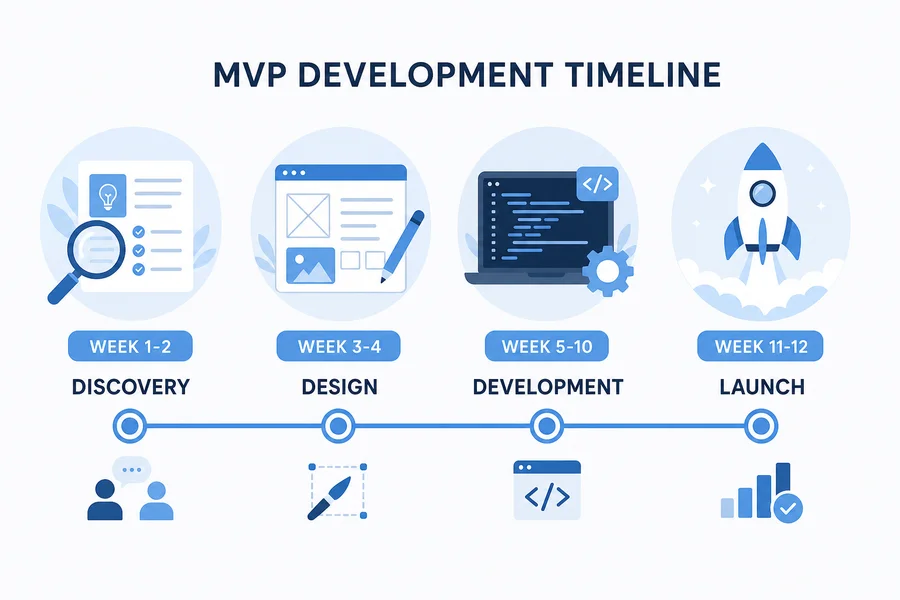
Based on projects we deliver for startups in India, the US, UK, Australia, and the Middle East, here are typical MVP development cost ranges in 2026:
| MVP Type | Scope | Estimated Cost (2026) | Timeline |
|---|---|---|---|
| Simple MVP | 1 platform (web OR mobile), 5–8 core screens, basic auth, admin panel | $8,000 – $18,000 | 6–10 weeks |
| Standard MVP | Web + mobile OR cross-platform app, payments, notifications, dashboards | $18,000 – $40,000 | 10–16 weeks |
| Complex MVP | Multi-role systems, integrations (APIs, CRM, AI), real-time features | $40,000 – $80,000+ | 16–24+ weeks |
| Enterprise / Regulated | Healthcare, fintech, compliance-heavy workflows | $60,000 – $150,000+ | 20–30+ weeks |
Note: These are industry benchmarks for custom development. No-code or template-based MVPs may cost less but often limit scalability. Offshore teams in India typically deliver 40–60% cost savings versus US-based agencies for comparable quality.
What Factors Affect MVP Development Cost?
Every founder receives different quotes because these variables change the effort dramatically:
1. Product Scope and Features
Each feature — user registration, social login, payment gateway, chat, geolocation, push notifications, analytics dashboards — adds design, development, and testing time. The biggest cost driver is not “number of screens” but business logic complexity. A marketplace MVP with vendor onboarding, commissions, and payouts costs significantly more than a content app with subscriptions.
2. Platform Choice: Web, iOS, Android, or Cross-Platform
Building natively for iOS and Android doubles mobile effort. In 2026, Flutter and React Native remain popular for startups that need both platforms from one codebase. A responsive web app MVP is often the fastest path to validate B2B ideas before investing in mobile.
3. UI/UX Design Depth
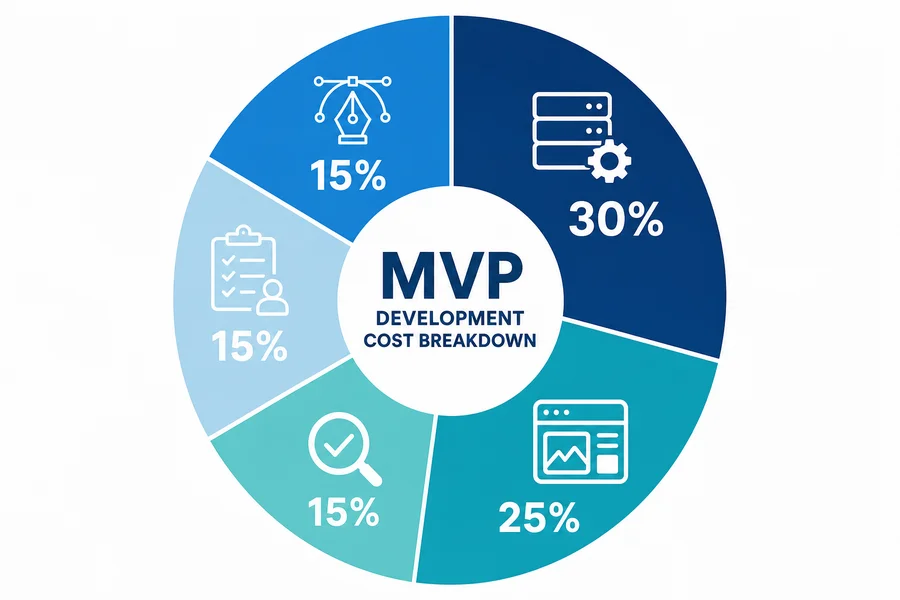
Custom UI/UX with user research, wireframes, and interactive prototypes adds $2,000–$8,000+ depending on screen count. Skipping design saves money short-term but often leads to expensive rework after user testing.
4. Backend and Infrastructure
Serverless backends, Firebase, Supabase, or custom Node.js/Laravel APIs — each has different build and scaling costs. Real-time features, third-party API integrations, and admin panels increase backend complexity.
5. Team Location and Engagement Model
Hiring a dedicated offshore development team in India, working with a boutique agency, or assembling freelancers on Upwork produces very different cost and risk profiles. Agencies offer project management, QA, and accountability; freelancers may be cheaper but require more founder oversight.
6. AI and Advanced Features
Adding AI chatbots, recommendation engines, or document processing in 2026 can add $5,000–$25,000+ depending on whether you use pre-built APIs (OpenAI, Gemini) or custom models.
MVP Cost Comparison by Region (2026)
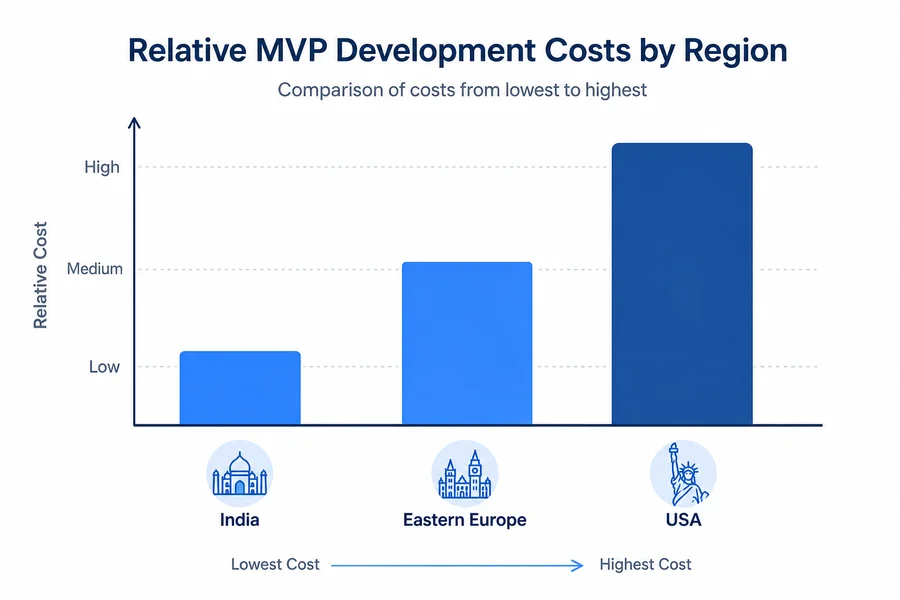
Geography remains one of the strongest predictors of startup MVP development cost:
- India / South Asia: $15–$40/hour for experienced teams — best value for custom MVPs with strong English communication and timezone overlap with Western clients.
- Eastern Europe: $35–$70/hour — strong technical talent, moderate cost.
- United States / Western Europe: $80–$180+/hour — premium pricing, best for highly regulated or on-site collaboration needs.
For a standard 12-week MVP requiring roughly 800–1,200 development hours, an offshore partner in India might quote $20,000–$35,000 where a US agency could quote $80,000–$150,000 for similar scope.
MVP Development Cost by Product Category (2026)
Different product types carry different baseline costs. Here is what founders in our network typically spend:
- On-demand / marketplace MVP (Uber-like, service booking): $25,000 – $55,000 — multi-sided logic, geolocation, payments, and rating systems add complexity.
- SaaS MVP (subscription web app): $18,000 – $45,000 — focus on auth, billing, dashboards, and role-based access.
- Mobile app MVP (single-purpose consumer app): $12,000 – $35,000 — depends heavily on native vs cross-platform and backend needs.
- Healthcare / fintech MVP: $45,000 – $100,000+ — compliance, security audits, and data privacy requirements extend timelines and cost.
- AI-powered MVP: $20,000 – $50,000 — scope varies widely based on custom ML vs API-based intelligence.
If your idea fits one of these categories, use the range as a starting point — then adjust up or down based on your specific feature list.
Hidden Costs Founders Often Miss
When budgeting MVP development cost in 2026, plan for these commonly overlooked expenses:
- App store fees — Apple Developer Program ($99/year), Google Play ($25 one-time)
- Cloud hosting — AWS, Google Cloud, or Azure ($50–$500+/month as you scale)
- Third-party services — Stripe, Twilio, SendGrid, Maps API, analytics tools
- Domain, SSL, and email — modest but recurring
- Post-launch maintenance — budget 15–20% of initial build cost annually for bug fixes and OS updates
- Marketing and user acquisition — your MVP budget should not consume 100% of seed funding
How to Reduce MVP Development Cost Without Sacrificing Quality
After helping hundreds of startups launch MVPs, we recommend these proven strategies:
- Define one core user journey. Solve one problem exceptionally well instead of five problems poorly.
- Use proven tech stacks. Flutter, React, Node.js, and Laravel reduce risk and speed up hiring.
- Build modularly. Launch Phase 1 with must-have features; queue nice-to-haves for v1.1.
- Choose an experienced MVP agency. A slightly higher rate with faster delivery often costs less than a cheap team that misses deadlines.
- Invest in discovery. A 1–2 week discovery phase ($2,000–$5,000) prevents $20,000+ in rework.
- Plan for analytics from day one. Knowing how users behave is more valuable than an extra feature nobody uses.
MVP Development Cost vs. Full Product Cost
Founders sometimes confuse MVP pricing with full product pricing. A $25,000 MVP is not a $25,000 “finished app.” It is a validation tool. Your full product — with advanced features, scalability hardening, compliance, and growth tooling — may cost 2–4x the MVP investment over 12–18 months. The MVP’s job is to prove demand before you commit that larger spend.
When Should You Hire an MVP Development Company?
Consider partnering with an MVP development company when:
- You have a clear idea but no technical co-founder
- You need to launch within 8–16 weeks to meet investor or market milestones
- You want a team that handles design, development, QA, and deployment end-to-end
- You are targeting multiple markets and need a scalable architecture from the start
At Ganesha WebTech, we specialize in MVP development for startups worldwide — combining lean scope discipline with production-grade engineering so you can validate fast and scale confidently.
Conclusion: What Should You Budget for Your MVP in 2026?
For most startups in 2026, a realistic MVP development budget is:
- $8,000–$18,000 for a lean web or mobile MVP with core features only
- $18,000–$40,000 for a market-ready MVP with polished UX and essential integrations
- $40,000–$80,000+ for complex products with multiple user roles, real-time features, or compliance needs
The right number for your project depends on scope — not hype. Get a detailed estimate based on your feature list, target platforms, and launch timeline rather than a generic per-hour quote.
Get a Free MVP Cost Estimate
Share your idea with Ganesha WebTech and receive a tailored MVP development quote within one business day — no obligation.
Frequently Asked Questions
How much does it cost to build an MVP app in India in 2026?
Most custom MVP apps built by experienced Indian development companies range from $8,000 to $40,000 USD depending on complexity. Simple apps with basic features start around $8,000–$15,000, while cross-platform apps with payments and admin panels typically fall in the $20,000–$40,000 range.
How long does MVP development take?
A focused MVP typically takes 6 to 16 weeks. Simple products can launch in 6–8 weeks; standard MVPs with custom design and backend integrations usually need 10–16 weeks.
Is it cheaper to use no-code for an MVP?
No-code tools can work for very simple workflows under $500/month, but they often create scalability and customization limits. For funded startups planning to grow, custom MVP development usually delivers better long-term ROI.
What is included in a typical MVP development quote?
A professional quote should include scope document, UI/UX design, frontend and backend development, QA testing, deployment, source code ownership, and a defined support period. Always clarify what is excluded — such as app store marketing, ongoing maintenance, and third-party API fees.
Can I raise funding with just an MVP?
Yes. Many seed-stage investors in 2026 expect a working MVP or high-fidelity prototype plus early traction metrics — signups, retention, or revenue — rather than a pitch deck alone.